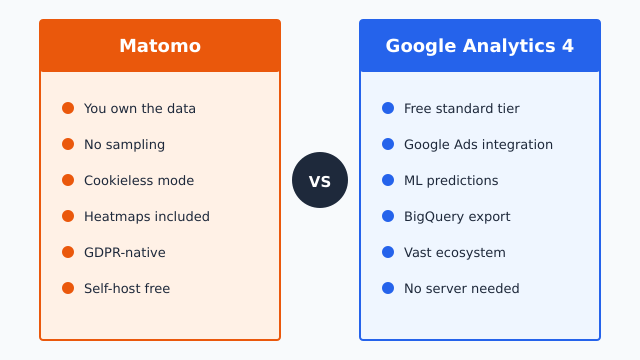
Google Analytics is free and very popular. But in Europe, it keeps running into trouble. The reason is simple. When a European visitor lands on your site, Google Analytics sends their data to servers in the United States. EU privacy law puts strict limits on sending people’s data outside Europe. Several EU regulators have ruled that this transfer breaks the law. So the safe move is to use a tool that keeps the data in Europe.
Why the data leaving Europe is the problem
Europe’s privacy law is called the GDPR. It protects personal data, like a person’s IP address or how they move around your site. The law says you can’t just ship that data to a country with weaker rules.
That’s the catch with Google Analytics. Google’s servers sit in the US. When someone from Europe visits you, their data flies across the ocean to those servers. Once it’s there, US law lets the government look at it. Europe’s rulers say that’s not safe enough.
Think of it like mailing a letter
Imagine you promise a friend their letters stay private. Then you mail those letters through a country that opens every envelope it wants. You broke your promise, even if you never meant to. It doesn’t matter how careful you were. The letter still left your safe hands.
That’s what happens with Google Analytics. The data leaves Europe and lands somewhere it can be read. The promise to keep it private is already broken.
This really happened
This isn’t just a worry. In 2022, Austria’s privacy office checked a website using Google Analytics. The site owner had even tried to hide visitor IP addresses. The office still said no. The data reached the US first, and that broke the rule.
Soon after, France, Italy, and Sweden said the same thing. Sweden even handed out fines. So this is a real risk, not a maybe.
What you should do
You have two paths. You can keep Google Analytics and add a lot of legal work and settings to lower the risk. But the data still leaves Europe, so the worry never fully goes away.
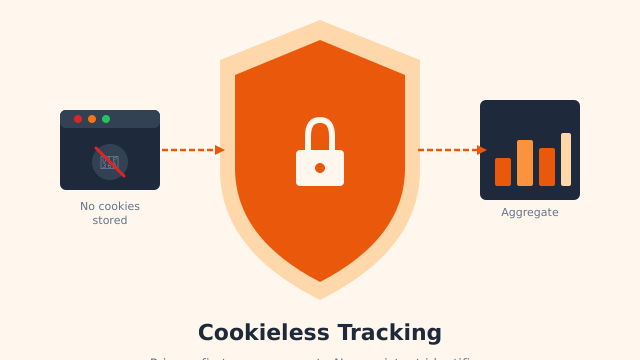
The easier path is to pick a privacy-friendly tool that keeps data in Europe. These tools don’t store IP addresses or track people across sites. They skip the whole problem instead of patching it.
You give up some fine detail. You can’t follow one person across days and devices. But for most site owners, that detail isn’t needed. You still see your page views and where visitors came from. That answers most of your questions.
So here’s the one thing to do first. If your visitors are in Europe, look at a tool that stores data there. It’s the simplest way to stay on the right side of the law.

 Nathan Hollis
·
2 min read
Nathan Hollis
·
2 min read