
Is Google Analytics GDPR Compliant? What EU Rulings Mean for Your Site
Google Analytics is the world’s most widely used web analytics tool. It’s also the one that keeps getting…

Cookie banners slow down conversions and annoy visitors. Plausible Analytics is built around the proposition that you shouldn’t need one — and after running it alongside GA4 on a client blog for a month, I think it largely delivers on that promise. Here’s a hands-on look at where it shines, where it falls short, and whether it’s actually worth switching from Google Analytics.
Plausible is a lightweight, privacy-first web analytics tool built by a small team in Europe. It launched in 2019 as a direct reaction to GA’s growing complexity and GDPR complications. The core idea: give you the traffic data you actually use, strip out everything else, and do it without touching visitor cookies.
It’s open source under the AGPL-3.0 licence, which means you can inspect the code, contribute, or self-host the entire thing on your own infrastructure. The hosted version runs on EU-based servers (the company is based in Estonia). That distinction matters if your legal team is nervous about US-based data processors.
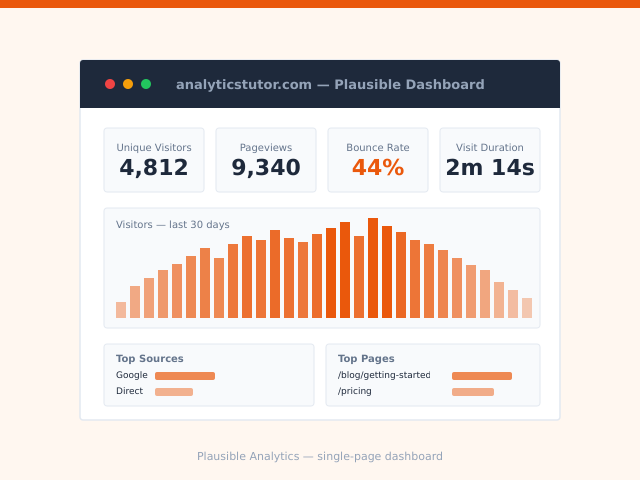
The result is a dashboard that fits on a single screen. No hidden menus. No 47-metric event explorer. You see visitors, pageviews, bounce rate, visit duration, top sources, top pages, and countries — all on one page, without sampling.
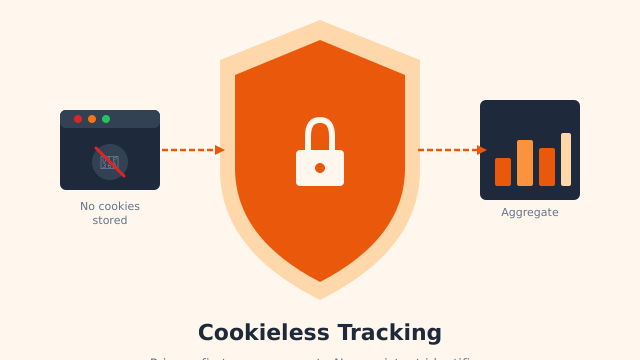
Plausible does not use cookies or local storage to track visitors. Instead it derives a daily-rotating anonymous hash from the visitor’s IP address, user agent, and a server-side salt. No persistent identifier crosses the visitor’s device. As a result, the tool is GDPR-compliant out of the box, without needing a cookie consent banner — a claim Plausible has written up in detail in their public data policy.
Worth being precise here: you still need a basic privacy policy that mentions your analytics tool. What you avoid is the Consent Management Platform (CMP) popup that blocks the page until a visitor clicks. That alone removes a meaningful friction point on mobile.
The European Data Protection Board’s guidance on analytics cookies is why so many EU sites now open with a wall of consent toggles. Plausible’s cookieless model sidesteps that entirely — which is why I flagged it as worth investigating for a client running a health information blog with heavy German traffic.
Plausible’s tracking script is about 2.5 KB — dramatically lighter than Google’s ~135 KB gtag.js. The open-source codebase is auditable if you want to verify that. On a mobile connection in emerging markets, that’s a real performance difference — and Core Web Vitals scores reflect it.
In practice, I saw a measurable improvement in Time to Interactive on the client site after the switch. It wasn’t dramatic — about 0.4 seconds — but it was consistent across multiple Lighthouse runs.
Everything lives on one screen: the line graph at the top, then cards for Sources, Pages, Countries, Devices, and Operating systems below it. You filter by clicking any row. Want to see which pages French visitors read on mobile? Three clicks. In GA4 the same query involves building a custom exploration report.
For most content site owners, this is the killer feature. The friction of opening GA4 and remembering which report to use disappears.
You can track custom events by adding a data attribute to any HTML element or calling plausible('EventName') from JavaScript. Funnel analysis (multi-step conversion paths) is available on the Business plan and above. In my testing, setting up a simple form-submission goal took about five minutes — far quicker than the equivalent GA4 event + conversion marker setup.
One honest caveat: Plausible’s funnel visualisation is linear. If you need multi-path funnels or user-level session stitching across days, you’ll hit the ceiling quickly. For a standard “landing page → pricing page → signup” funnel, it works cleanly.
Plausible sends weekly email digests and can push daily/weekly summaries to Slack. These are configured per-site from the dashboard. It’s a small thing, but clients who don’t log in to dashboards regularly actually read the email summaries — something I can’t say for any automated GA4 report I’ve ever set up.
Because Plausible is fully open source on GitHub, you can run it on your own server. That gives you complete data sovereignty — useful for healthcare, legal, or finance sites where sending data to any third party is complicated. The self-hosted version requires Docker and a bit of server administration; it’s not click-to-install, but the documentation is solid.

Setup is genuinely fast. Here’s the full sequence:
<script> tag in your <head>:<script defer data-domain="yourdomain.com" src="https://plausible.io/js/script.js"></script>On WordPress, there’s a first-party Plausible plugin that handles snippet insertion and proxying the script through your own domain (useful for reducing ad-blocker interference). I’ve used both the manual snippet and the plugin — both work fine, though the proxy mode does meaningfully improve data completeness on ad-heavy topics.
Plausible has three plan tiers — Starter, Growth, and Business — with pricing based on monthly pageview volume. Annual billing saves roughly 17% (marketed as “2 months free”). Here’s the full matrix as of the current pricing page:
| Monthly pageviews | Starter | Growth | Business |
|---|---|---|---|
| 10k | $9/mo | $14/mo | $19/mo |
| 100k | $19/mo | $29/mo | $39/mo |
| 200k | $29/mo | $44/mo | $59/mo |
| 500k | $49/mo | $74/mo | $99/mo |
| 1M | $69/mo | $104/mo | $139/mo |
The plans differ in more than price. Starter covers 1 site; Growth allows up to 3 sites; Business covers up to 10 sites. Several features are Business-tier only: the Stats API, Looker Studio connector, ecommerce revenue tracking, and funnels. If those are on your list, factor that into which tier you actually need.
There’s no free tier after the 30-day trial. That’s a genuine trade-off against GA4, which is free at any traffic volume (though it has its own costs: complexity, compliance risk, and performance overhead).
If you’re spending hours a month managing cookie consent configurations for a site that gets 40,000 visitors a month, $19/month for Plausible is almost certainly cheaper than your time.

I don’t think it’s useful to review a tool without being direct about what it can’t do. Plausible has real constraints, and pretending otherwise wastes your time.
GA4 lets you look at individual user journeys — what someone did across multiple sessions, which pages they hit before converting. Plausible doesn’t. Data is aggregated by design; individual-level identification is architecturally off the table. If you run e-commerce where a customer might visit six times over three weeks before buying, you’ll miss that journey.
If your workflow involves exporting raw event data to BigQuery for custom queries or machine learning, Plausible isn’t a replacement for GA4. You can export aggregated CSVs, and the Stats API is capable for dashboarding — but raw event-level SQL queries aren’t part of the picture.
You can filter by source, medium, page, country, browser, device, and campaign. However, Plausible doesn’t support segment combinations with boolean logic (“visitors from organic search who also visited the pricing page and didn’t convert”). That kind of analysis requires GA4’s explorations or a dedicated BI tool.
GA4 is free. Plausible costs money after 30 days. For a hobby blog with no income, that’s a non-trivial objection. The privacy-first alternative that is free and self-hosted from day one is Matomo (though Matomo has its own setup complexity). It’s worth being honest: if budget is the primary constraint, this matters.
The deep integration between GA4 and Google Ads — audience lists, enhanced conversions, imported goals — doesn’t exist in Plausible. If paid search is your main acquisition channel, removing GA4 has meaningful downstream consequences for campaign optimisation.
For a deeper look at how Plausible stacks up specifically against Fathom and Rybbit, see my privacy analytics head-to-head comparison — that post is focused purely on differentiating between tools in the same category.
Based on hands-on use, here’s my honest breakdown:
Plausible is a strong fit if you run a content site, SaaS, or product blog — especially one with EU visitors. It’s also right for anyone who finds GA4’s interface a cognitive burden, or any site owner who’s been putting off GDPR compliance because setting up a CMP feels overwhelming. The privacy-first approach described in my guide to privacy-first analytics aligns closely with how Plausible is built.
Plausible is probably not the right tool if you rely on Google Ads integration, run an e-commerce store where session stitching matters, or work in an agency context where clients expect GA4 reports. It also won’t replace GA4 for teams that do serious data science work downstream of their analytics pipeline.
One nuance worth flagging: you don’t have to choose. Running both simultaneously for a month gives you a calibration picture — you can verify your Plausible numbers against GA4 before fully committing. That’s exactly what I did on the client blog, and it gave me confidence in the data before pulling the GA4 snippet.
If you’re thinking about building a broader analytics strategy that doesn’t depend on third-party cookies, the considerations in my first-party data strategy guide are worth reading alongside this review.

After using plausible analytics on real sites, my answer is: yes, for most content-focused websites — and especially for anyone with meaningful EU traffic who wants to stop worrying about GDPR cookie consent.
The dashboard genuinely tells you what’s happening on your site in under 30 seconds. The script is lightweight enough that it’s never a performance argument. The privacy model is thoughtful and well-documented. And the self-hosting option is a real differentiator for privacy-sensitive industries.
What it isn’t is a full replacement for GA4 in all scenarios. If you need user-level journey analysis, BigQuery exports, or Google Ads integration, GA4 stays relevant. But for the majority of site owners I’ve worked with — bloggers, indie SaaS founders, small business owners — those features are rarely used and the complexity they add is a real cost.
The honest plausible analytics review verdict: start the 30-day trial, run it alongside whatever you’re currently using, and see if you miss what you’re giving up. In my experience, most people don’t.
If you’re curious how Plausible compares directly to its privacy-first competitors, the Plausible vs Fathom vs Rybbit breakdown covers that comparison in detail.