First-Party Data Strategy: Building Analytics Without Third-Party Cookies

Third-party cookies are dying. Safari killed them years ago. Firefox followed. Chrome keeps delaying the inevitable, but the direction is clear: the era of tracking users across the web through third-party cookies is ending.

For marketers and analysts, this sounds like disaster. How do you track conversions? Measure campaign performance? Understand your audience?

The answer isn’t to find workarounds or pray for delays. The answer is to build a first-party data strategy — collecting data directly from your users, on your own properties, with their knowledge and consent.

This isn’t just a compliance move. Companies with strong first-party data consistently outperform competitors in targeting accuracy, customer understanding, and marketing efficiency. Here’s how to build that foundation.

First-Party, Third-Party, Zero-Party: What’s the Difference?

Before diving into strategy, let’s clarify terms that often get confused:

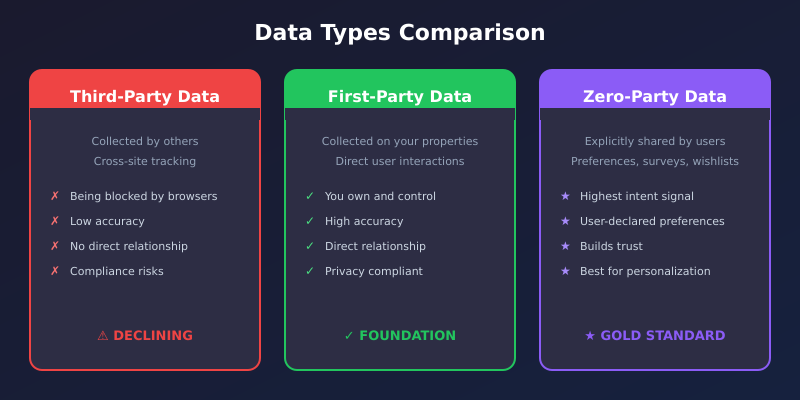
Third-Party Data (The Dying Model)

Third-party data is collected by entities that don’t have a direct relationship with users. Ad networks drop cookies on millions of sites, tracking users as they browse, building profiles across domains they don’t own.

This model is collapsing because:

  • Browsers are blocking third-party cookies by default
  • Privacy regulations (GDPR, CCPA) require explicit consent
  • Users increasingly opt out when given the choice
  • Apple’s App Tracking Transparency devastated mobile tracking

First-Party Data (Your Foundation)

First-party data is information you collect directly from your audience on properties you own — your website, app, email list, or CRM. When someone creates an account, makes a purchase, or fills out a form on your site, that’s first-party data.

First-party cookies — small text files your own domain sets — are not going away. They’re essential for basic website functionality: remembering login states, shopping carts, and user preferences.

Zero-Party Data (The Gold Standard)

Zero-party data is information users intentionally and proactively share. Preference centers, surveys, quiz results, wishlists — data they volunteer because they see value in sharing it.

Zero-party data is the most valuable because intent is explicit. When a user tells you they’re interested in hiking gear, that signal is stronger than inferring it from browsing behavior.

Comparison of third-party, first-party, and zero-party data collection methods

Why First-Party Data Is Actually Better

The shift to first-party data isn’t just about compliance — it’s a competitive advantage. Here’s why:

1. Higher Accuracy

Third-party data is probabilistic and often wrong. It’s based on cookies that might belong to multiple users sharing a device, inferred interests that miss context, and data that’s weeks or months old.

First-party data comes directly from the source. When a customer tells you their email, purchases a product, or specifies preferences, that information is accurate by definition.

2. Better Customer Relationships

First-party data collection requires building relationships. You can’t just harvest data invisibly — you need to provide value that makes users want to share information. This forces better customer experiences.

3. Full Ownership and Control

Third-party data lives in someone else’s platform. Algorithm changes, policy updates, or company shutdowns can eliminate access overnight. First-party data is yours — portable, permanent, and independent of any platform’s whims.

4. Regulatory Resilience

Privacy laws keep tightening. Building on first-party data with proper consent means you’re not constantly scrambling to comply with the next regulation. You’re already ahead.

Five Pillars of First-Party Data Collection

Building a first-party data strategy isn’t about implementing one tool — it’s about creating multiple touchpoints where users willingly share information. Here are the five pillars:

Five pillars of first-party data collection: authentication, transactions, engagement, declared preferences, and feedback

1. Authentication Events

Logged-in users are first-party data gold. Every action they take is tied to a persistent identity you control.

Tactics to increase authentication:

  • Offer genuine value for creating accounts (order history, wishlists, saved preferences)
  • Enable social login to reduce friction
  • Implement progressive profiling — don’t ask for everything upfront
  • Create members-only content or features
  • Use loyalty programs that require login

The key is providing clear value exchange. “Create an account to checkout faster” beats “Sign up for our newsletter” every time.

2. Transaction Data

Every purchase, subscription, or conversion generates first-party data: what was bought, when, at what price, through which channel.

Maximize transaction data value:

  • Capture complete purchase context (device, referral source, time to conversion)
  • Track product affinities and purchase sequences
  • Connect offline and online transactions where possible
  • Build RFM models (recency, frequency, monetary value) from your own data

3. Behavioral Engagement

On-site behavior — pages visited, content consumed, features used — is first-party data when collected on your own properties with first-party cookies or server-side tracking.

Key engagement signals:

  • Content consumption patterns (topics, formats, depth)
  • Product browsing behavior (categories, price ranges, comparison patterns)
  • Feature usage in apps or tools
  • Email engagement (opens, clicks, forwards)
  • Search queries on your site

This behavioral data powers personalization without requiring cross-site tracking. For deeper analysis, see our guide to funnel analysis.

4. Declared Preferences (Zero-Party)

The most valuable data is what users explicitly tell you. Create opportunities for preference declaration:

  • Preference centers: Let users control what emails they receive, what topics interest them
  • Onboarding flows: Ask new users about their goals, experience level, or use case
  • Interactive content: Quizzes, assessments, or configurators that capture preferences while providing value
  • Wishlists and favorites: Users explicitly flagging items they want
  • Profile enrichment: Optional fields users can complete over time

The key is reciprocity. Users share preferences when they see immediate benefit: better recommendations, relevant content, personalized experiences.

5. Feedback and Research

Direct feedback channels generate high-quality first-party data:

  • NPS and satisfaction surveys: Quantified sentiment tied to customer records
  • Post-purchase surveys: Why they bought, what influenced decision
  • Support interactions: Issues, questions, and resolution data
  • Reviews and testimonials: Public declarations of opinion
  • User research: Interviews, usability tests, beta feedback

Technical Infrastructure for First-Party Data

Strategy is nothing without execution. Here’s the technical foundation you need:

Server-Side Tracking

Client-side JavaScript tracking is increasingly unreliable. Ad blockers, browser restrictions, and network issues cause significant data loss. Server-side tracking solves this by sending data directly from your server.

Benefits of server-side tracking:

  • Bypasses ad blockers and browser restrictions
  • Reduces page load impact (no heavy client scripts)
  • Gives you full control over what data is collected and shared
  • Enables data enrichment before sending to analytics platforms

Tools like server-side GTM, Segment, or custom implementations make this increasingly accessible.

Customer Data Platforms (CDPs)

A CDP unifies first-party data from multiple sources into persistent customer profiles. When the same person visits your website, opens an email, and makes a purchase, a CDP connects those touchpoints.

CDP capabilities:

  • Identity resolution across devices and channels
  • Unified customer profiles from fragmented data
  • Audience segmentation based on first-party attributes
  • Activation to marketing tools (email, ads, personalization)

Options range from enterprise solutions (Segment, mParticle, Tealium) to lighter alternatives (RudderStack, Freshpaint) depending on your scale and budget.

Privacy-First Analytics

Traditional analytics tools were built for the third-party cookie era. Privacy-first analytics platforms like Plausible, Fathom, or Matomo are designed for first-party data collection without invasive tracking.

These tools prove you can understand key metrics like traffic sources, popular content, and conversion paths without tracking individuals across the web.

Technical stack for first-party data: server-side tracking, CDP, privacy-first analytics, and consent management

Consent Management

First-party data still requires proper consent. A consent management platform (CMP) handles:

  • Cookie consent collection and storage
  • Preference management across data types
  • Consent state propagation to analytics and marketing tools
  • Audit trails for compliance documentation

The goal is informed, granular consent — not dark patterns that trick users into accepting everything.

First-Party Data Strategy Checklist

Ready to build your first-party data foundation? Here’s a practical checklist:

Audit Current State

  • ☐ Map all current data collection points
  • ☐ Identify dependencies on third-party cookies
  • ☐ Assess data quality and completeness
  • ☐ Review consent mechanisms and compliance
  • ☐ Document where first-party data currently lives

Build Collection Infrastructure

  • ☐ Implement server-side tracking for critical events
  • ☐ Set up first-party cookie domain (same domain as website)
  • ☐ Deploy proper consent management
  • ☐ Create authenticated user experiences worth logging into
  • ☐ Build preference centers and progressive profiling

Unify and Activate

  • ☐ Connect data sources to unified customer view
  • ☐ Implement identity resolution strategy
  • ☐ Build segments based on first-party attributes
  • ☐ Create activation workflows to marketing tools
  • ☐ Establish measurement framework for first-party campaigns

Optimize Value Exchange

  • ☐ Test incentives for account creation and data sharing
  • ☐ Improve personalization based on first-party signals
  • ☐ Measure and communicate value users receive
  • ☐ Continuously reduce friction in data collection
  • ☐ Respect preferences and make opt-out easy

Common Mistakes to Avoid

Building a first-party data strategy isn’t just about collecting more data. Watch out for these pitfalls:

1. Asking for Too Much Too Soon

Long registration forms kill conversions. Start with the minimum needed, then progressively collect more as trust builds. A returning customer who’s made three purchases will share more than a first-time visitor.

2. Collecting Without Purpose

Every data point should have a clear use case. Collecting birth dates “just in case” creates liability without value. Define how you’ll use data before collecting it.

3. Ignoring Data Quality

First-party data is only valuable if it’s accurate and current. Implement validation, deduplication, and regular hygiene processes. Bad data is worse than no data — it leads to confident wrong decisions.

4. Siloed Data

First-party data scattered across disconnected tools is nearly as useless as not having it. Invest in integration and unified customer views.

5. Dark Patterns in Consent

Tricking users into consent through confusing interfaces or pre-checked boxes might work short-term but destroys trust and invites regulatory scrutiny. Transparent consent builds sustainable first-party data.

The Bottom Line

The end of third-party cookies isn’t a crisis — it’s an opportunity. Companies that build strong first-party data strategies will have more accurate data, better customer relationships, and sustainable competitive advantages.

The formula is straightforward:

  1. Provide value that makes users want to engage with you directly
  2. Collect data through authentication, transactions, behavior, preferences, and feedback
  3. Unify everything into persistent, accurate customer profiles
  4. Respect privacy with proper consent and transparent practices
  5. Activate insights to improve customer experiences and marketing effectiveness

Start now. Every day you wait is data you’re not collecting, relationships you’re not building, and advantages you’re ceding to competitors who’ve already made the shift.

Nathan Hollis

Written by

Nathan Hollis

Web analytics consultant with 15+ years of experience helping businesses turn raw data into actionable insights. I believe analytics should be practical, understandable, and — dare I say — enjoyable.

Leave a Comment