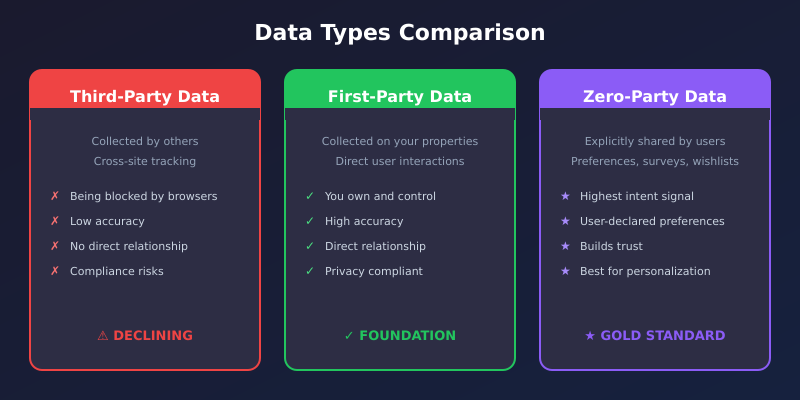
First-party data is the information a website gathers straight from its own visitors. You collect it yourself, on your own site. No outside company hands it to you. Because you got it firsthand, you can trust it. And it keeps working even when browsers block tracking from other companies.
What does “first-party” mean?
The word “party” just means a group involved in something. You are the first party. Your visitor is the second party. Anyone else is a third party.
So first-party data is what your visitor does on your site, recorded by you. Things like the pages they open, the form they fill in, or the order they place. You saw it happen. You wrote it down. That makes it yours.
A simple way to picture it
Think about a small shop you own. When a customer walks in, you notice what they look at. You remember what they buy. You can chat and ask what they need. That is firsthand knowledge. It is fresh and it is true.
Now imagine paying a stranger outside to guess who walks past your door. Their notes are vague. Sometimes they are flat wrong. That is the other kind of data, and it is the kind browsers are shutting off.
Why it stays reliable
Web browsers used to let outside companies follow people from site to site. Now most browsers block that. So data from those outside companies has big holes in it.
First-party data does not have that problem. It comes from your own site, not from someone tagging along. The browser is not blocking you on your own pages. So your numbers stay steady while the borrowed kind falls apart.
A quick example
Say 1,000 people visit your site this week. Your own site tracks all 1,000. That is first-party data. Clean and complete.
An outside tracker might only catch 400 of them. The other 600 are blocked. So its report shows less than half the real picture. Yours shows the whole thing.
What to do about it
Lean on the data you collect yourself. Watch what people actually do on your pages. Ask visitors for their email when they want something useful, like a guide or an account. That is information they give you on purpose, and it stays yours.
One thing to do today: open your site’s analytics and check that your own tracking is on and working. That is your first-party data. Make sure you are keeping it.

 Nathan Hollis
·
3 min read
Nathan Hollis
·
3 min read