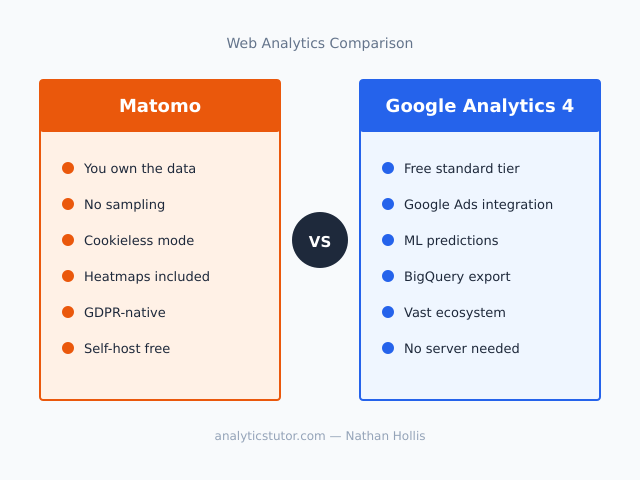
When people sit down to choose a website tracking tool, they argue about prices and features. But the real question is simpler. Who gets to keep the data about your visitors? With Google Analytics, Google keeps it. With Matomo, you keep it yourself. That one fact changes more than you’d think.
What “your data” really means
Every time someone visits your site, little facts get recorded. What page they opened. What country they came from. What link they clicked. Put it all together and that’s your visitor data. It tells you how your site is doing.
The big question is where that data lives. Does it sit on a company’s giant computers, or on yours? Whoever holds it gets to decide what happens to it. They can keep it, study it, or share it. That’s real power over something you made.
Think of it like photos
Say you take photos at a party. You can hand the camera to a friend who keeps every photo and shows you nice prints when you ask. Or you can keep the camera and the photos yourself.
Google Analytics is the friend. It does the work and shows you clean reports. But Google holds the raw photos. Matomo hands you the camera. The data stays with you, on a computer you control.
Neither way is wrong. They just give you different things. One is easy. The other gives you control.
A quick example
Imagine your site got 5,000 visits last month. Both tools count them fine and draw you charts.
Now say you want the full raw list of all 5,000 visits, not just the summary. With Matomo you can grab it. It’s yours. With Google Analytics, you only get what Google chooses to show. You can’t simply walk off with the whole pile.
So which should you pick?
Ask yourself one thing. Do you care who holds your visitor data?
If you just want quick, free charts and don’t mind Google keeping the raw data, Google Analytics is fine. If you want to own that data and keep it private, Matomo is the better fit. Owners in strict fields like health, finance, or law often pick Matomo for exactly that reason. For a simple blog, the free Google option is usually enough, so don’t overthink it.
Here’s your first step. Open whatever tool you use today. Find out where it stores your data. If you can’t answer that, you don’t really own it yet.
 Nathan Hollis
·
2 min read
Nathan Hollis
·
2 min read